The vineyard behind this wine carries the name of a castle that fell in 1433.
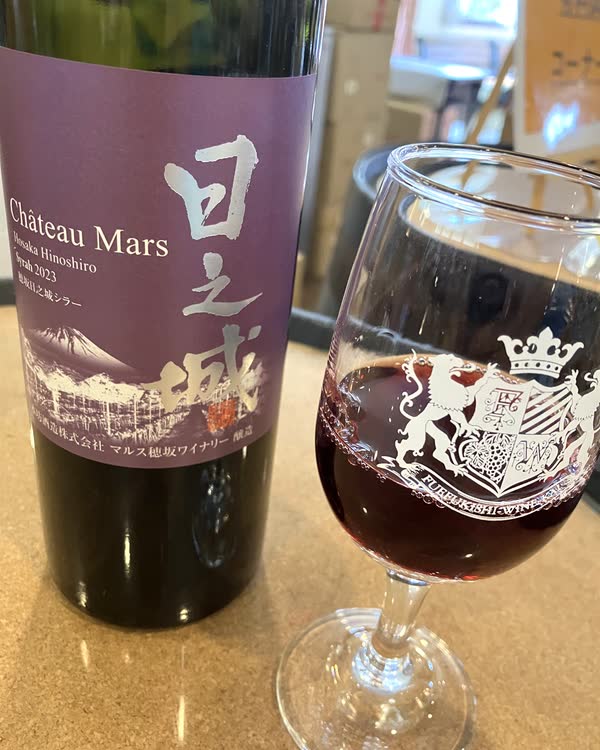
Château Mars Hosaka Hinoshiro Syrah 2023. I drank it at Mars Yamanashi Winery, in Isawa, Fuefuki City.
Out front, barrels are stacked into a wall, each one painted with the name: Mars Wine. But look closely at the label in my hand and it reads "brewed at Mars Hosaka Winery, Hombo Shuzo Co."
Hosaka is on the other side of the Kofu basin from here. The place on the label and the place I was drinking in are not the same place. Pull on that thread and you arrive at a castle, and at the history of Japanese whisky.
The vineyard sits on a hill at 500 metres
The grapes grow at Hinoshiro Farm, in Hosaka, Nirasaki City, Yamanashi. It is a hill at the southwest foot of Mt. Kayagatake, and the vines sit at around 500 metres — higher than the top of Tokyo Tower.
The slope faces southeast, rising about one metre for every twelve you walk. Gentle. The sun reaches it from early morning, and this is one of the sunniest places in all of Japan. The soil is red clay.
Two point two hectares, roughly three football pitches. Planted in 2000. Mt. Fuji stands directly in front of it.
"Hinoshiro" is not a name the farm invented
The farm did not choose the name because it sounded good. It is the name of the land itself.
There was a castle here once. Hinode Castle.
About six hundred years ago a warlord named Takeda Nobunaga took it — no relation to the famous Oda Nobunaga. He lived over a century before Takeda Shingen, at a time when the Takeda house had fallen on hard times. He gathered his warriors here, and the story goes that he meant to make this hill the place the Takeda would rise from again.
In the spring of 1433, he fought a rival band on the riverbed, and lost.
A hundred and fifty years later, Tokugawa Ieyasu is said to have rebuilt the castle and used it himself. The western side drops away into a cliff — hard ground to attack. Place names from those days still cling to the area: Toride, "the fort"; Ushigababa, "the ox pasture." It is a historic site protected by Nirasaki City.
A hill where the Takeda tried to rise and couldn't. European vines grow on it today. Syrah ripens there.
Why is a shochu company making wine?
The winery belongs to Hombo Shuzo, founded in Kagoshima in 1872 — as a shochu company. Not a wine company.
Even the name Mars came out of an open competition to name their Western spirits line, chosen for the star that had been the company's symbol from the beginning.
In 1960 that shochu house built a Western spirits plant here in Isawa. It did not only make wine. It distilled whisky too. The man who designed it was Kiichiro Iwai.
The still at Isawa looked a lot like the one at Yoichi
In 1918, Iwai sent one of his junior men to Scotland.
That junior was Masataka Taketsuru. He learned to make whisky there and came home in 1920 with a report, which he handed to Iwai. It became known as the Taketsuru Notes.
Taketsuru himself went on to build Yamazaki in 1923, then left and built Yoichi in 1936. That part of Japanese whisky history is famous enough to be in the textbooks.
Iwai became an adviser to Hombo Shuzo in 1945, and in 1960 he designed the Isawa distillery — working from the notebook he had been handed forty years earlier. Which is why the still at Isawa looked so much like the one at Yoichi.
Yamazaki in 1923, Yoichi in 1936, Isawa in 1960. One notebook, carried back from Scotland, became three stills.
But the whisky at Isawa did not last. Distilling stopped in 1969. In 1985 the still was dismantled and carried to Miyada, in Nagano — what is now Mars Komagatake Distillery. The still Iwai designed crossed the mountains, and it is still running.
After the whisky left, Isawa became a house for wine
The underground barrel cellar was given over to raising it. Around 300,000 bottles rest down there, slowly, at 10 to 15 degrees.
Then in 2000 they opened the vineyard at Hinoshiro, and in 2017 built Mars Hosaka Winery three kilometres from it. The making moved next door to the grapes.
Hosaka on the label is where this wine was born. Isawa, where I was drinking it, is the second half of its life — bottled, and resting.
In the glass
That Syrah 2023. 635 bottles made this year. 13% alcohol. Deep garnet.
The spice you expect from Syrah has been rearranged into something Japanese — the bright prickle of sansho pepper, and a heat that lingers afterwards the way wasabi does.
On the label, Mt. Fuji and the rows of the vineyard, white on deep plum. That is the Fuji you see standing at Hinoshiro.
Six hundred years after the castle fell, that view goes into six hundred bottles a year.
Or maybe the castle never fell. It just came back as a winery.
The ground itself
| Elevation | Hosaka Hinoshiro Farm sits at about 500m — a southeast-facing slope at the southwest foot of Mt. Kayagatake, in Hosaka, Nirasaki City. The Isawa winery itself is on the floor of the Kofu basin |
|---|---|
| Sun and wind | Long hours of sunshine, and a wide day-to-night temperature swing, as hill country tends to have |
| Soil | Red clay, on a hillside spreading out from the volcanic foot of Mt. Kayagatake |
| Vineyard | 2.2 hectares, planted in 2000, southeast slope of roughly 1-in-12 |
※ Details of the site are drawn from Hombo Shuzo's own published material.
On the map
🍷 Find Mars Yamanashi Winery on the Wine Map
Further reading
- Hombo Shuzo — Hosaka Hinoshiro (official, in Japanese)
- Visiting Mars Hosaka Winery (official, in Japanese)
This article expands on a post published on X on 23 August 2026. See the original post.
This is the English edition of an article first written in Japanese. 日本語版はこちら.