Plenty of people reach for the word "rose" when they describe how a wine smells.
Thing is, there are twenty thousand kinds of rose.
Which is a problem. If you say a wine smells of rose and there are twenty thousand of them, the person listening is entitled to ask which rose. So I went and put my nose in a great many of them, to settle it.
The venue: Keisei Rose Garden, in Chiba.
Peak bloom shifts a little year to year, but it's around late May.
Keisei Rose Garden — 1,600 varieties, 10,000 plants
The main event is the rose garden itself (¥1,800 to enter in season).
There's also a garden centre where you can buy roses and take them home.
They stock other flowers, houseplants and herbs too — that part alone is a decent afternoon.
There's a café and a bakery, so you can spend the whole day on the site without hurrying.
And strawberry picking, which had the place full of families on the day I went.
Anyway — to the roses.
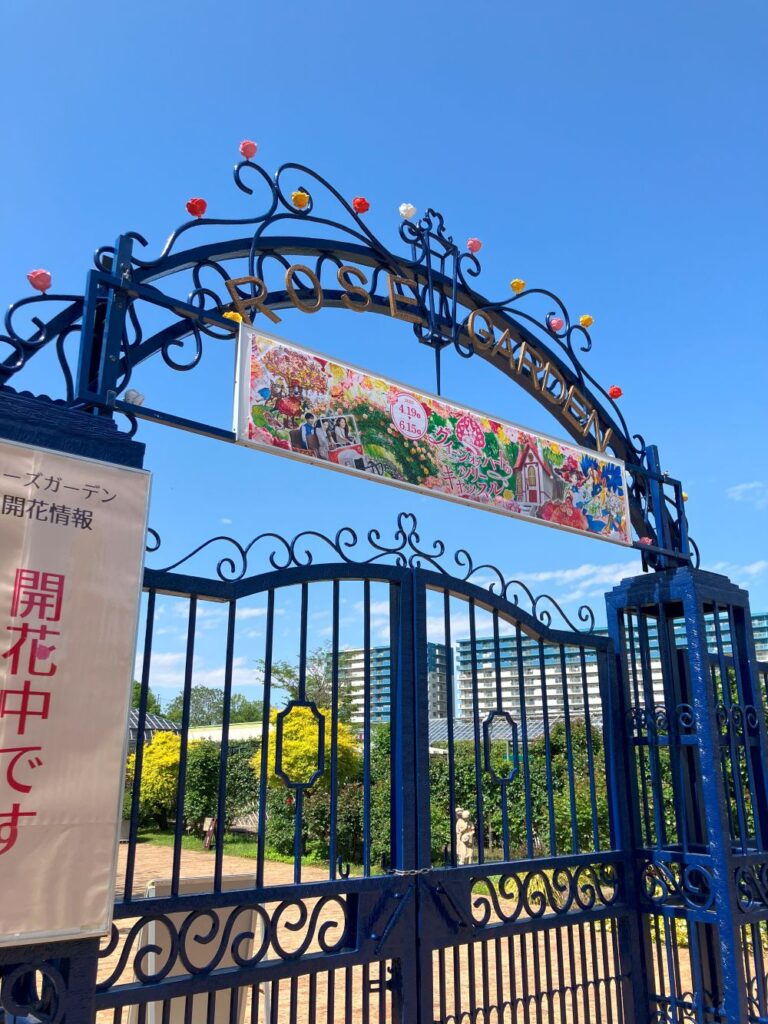
This was 29 April. Fine weather, strong direct sun — bring a hat and sunscreen.
And here it is:

Yes. The joke's on me: hardly anything is out yet. Peak is late May.
But a garden that green isn't empty either.
So I concentrated on the few roses that were kind enough to be flowering.
First was a bewitching purple thing called Shocking Blue.
🌹 Shocking Blue
A name that describes me, arriving before the season.
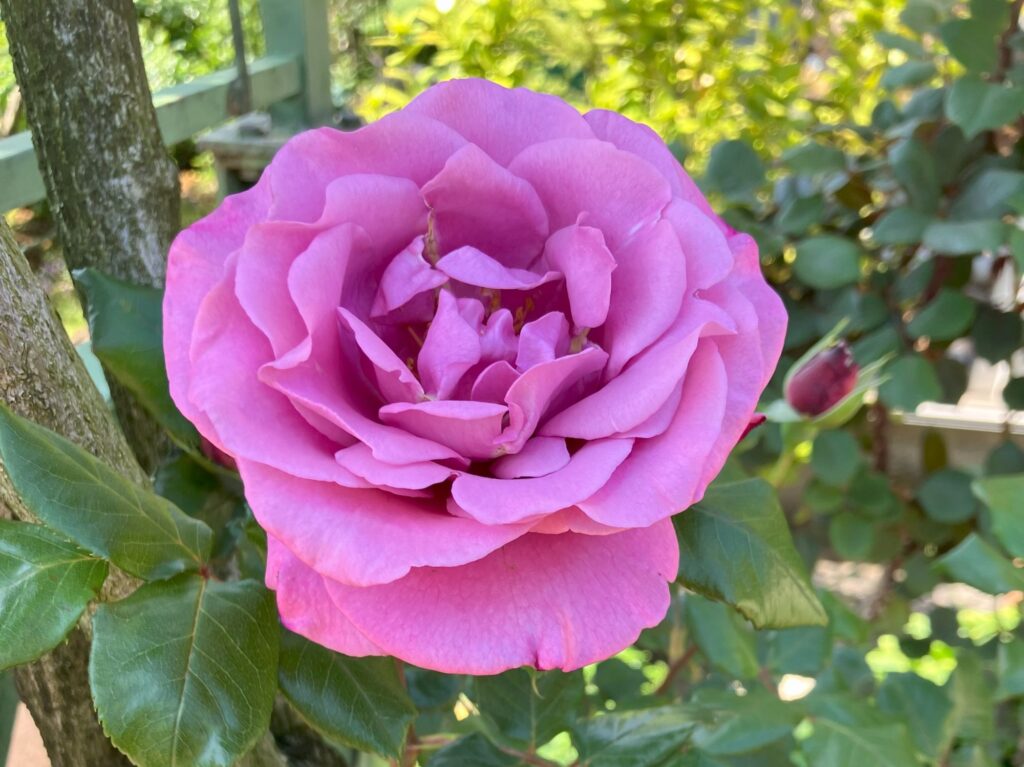
The scent reads as "dense," "austere," "green."
In wine terms: not an overripe Cabernet Sauvignon, but one picked at the right moment with its acidity intact — still some way from its drinking window, carrying a greenness that promises something, and enjoyable even now.
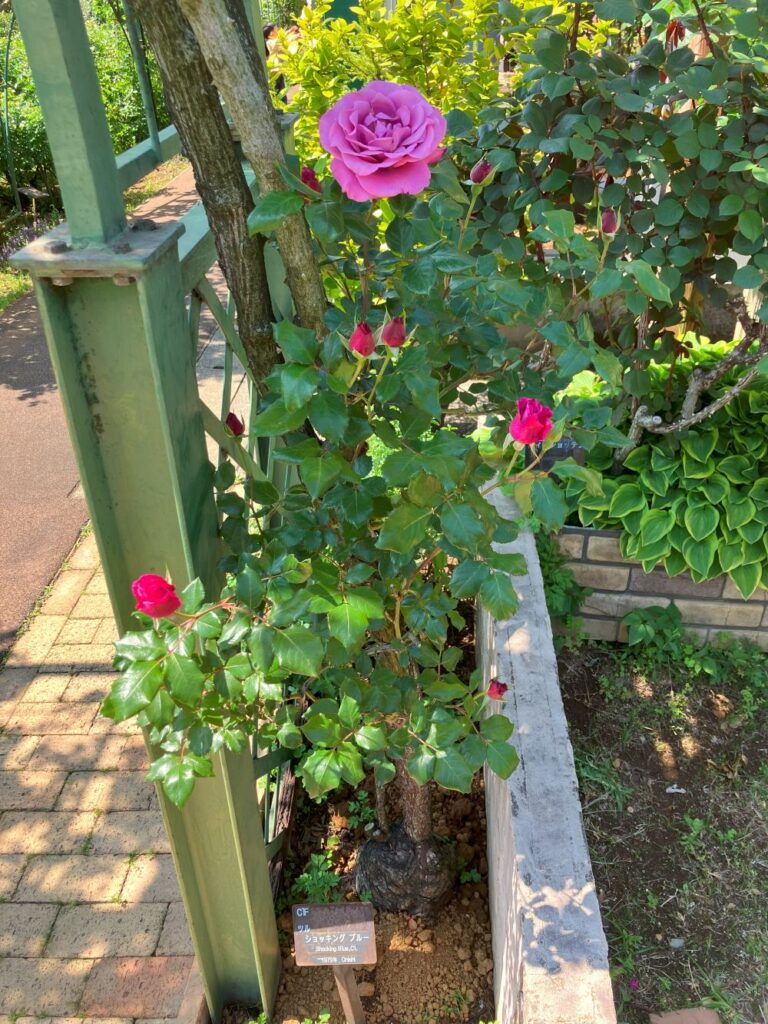
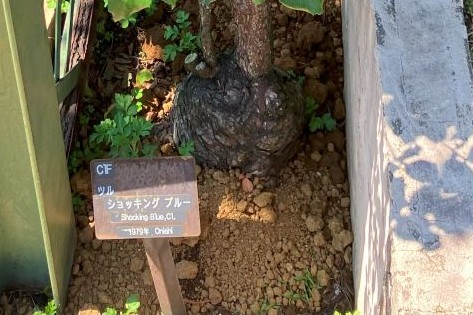
Look down at the base and it's grafted. Grafting is apparently as normal for roses as it is for vines. Sturdy-looking rootstock. I wonder whether they have to think about compatibility the way growers do.
Basics
- Class: Floribunda (FL)
- Bred in: Germany (Tantau)
- Year: 1981
- Colour: purple-tinged pink to lavender (one of the "blue rose" line)
- Scent: strong, notably spicy
- Form: rounded petals, cupped, medium bloom
- Habit: semi-upright, 80–100cm
Character
- As the name says, the draw is that blue-shot shocking pink to lavender colour.
- Very strongly scented, and complex — spice inside the sweetness.
- Flowers freely and repeatedly. Good in the ground, in a pot, or cut.
Next: Cocktail.
🌹 Cocktail
Sunlight yellow at the centre of the red. It reads as courage.
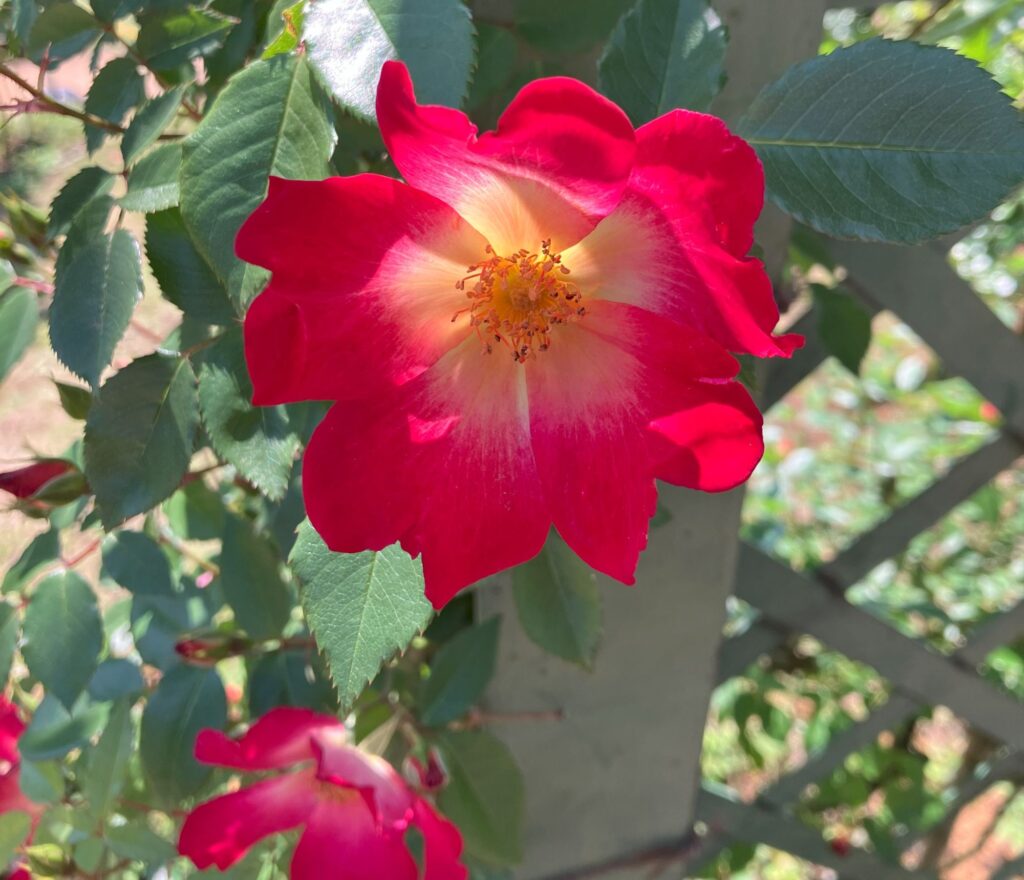
The scent is powdery. Like a powder room — the place women go to become still more formidable. Somewhere in there is gossip being traded and a determination to be the one who shines tonight.
In wine: a sun-filled Sangiovese, I think. Everyone enjoying themselves, conversation running, nobody standing on ceremony, and you leave ready to face tomorrow.

Basics
- Class: Shrub (S), sometimes treated as a climber (CL)
- Bred in: France (Meilland)
- Year: 1957
- Colour: single bloom, red with a yellow eye
- Scent: medium, fruity
- Form: single, medium bloom
- Habit: climbing, 1.5–2.5m (can be kept as a shrub with pruning)
Character
- That red-and-yellow two-tone really is as vivid as a cocktail.
- Single-flowered and slightly wild with it — good in a natural garden.
- Vigorous, and happy trained up a fence or an arch.
- Easy for beginners, and fairly disease-resistant.
Roses have personalities too, it turns out. Next.
Something that looks cold at first glance and then pulls you in: Iceberg.
🌹 Iceberg
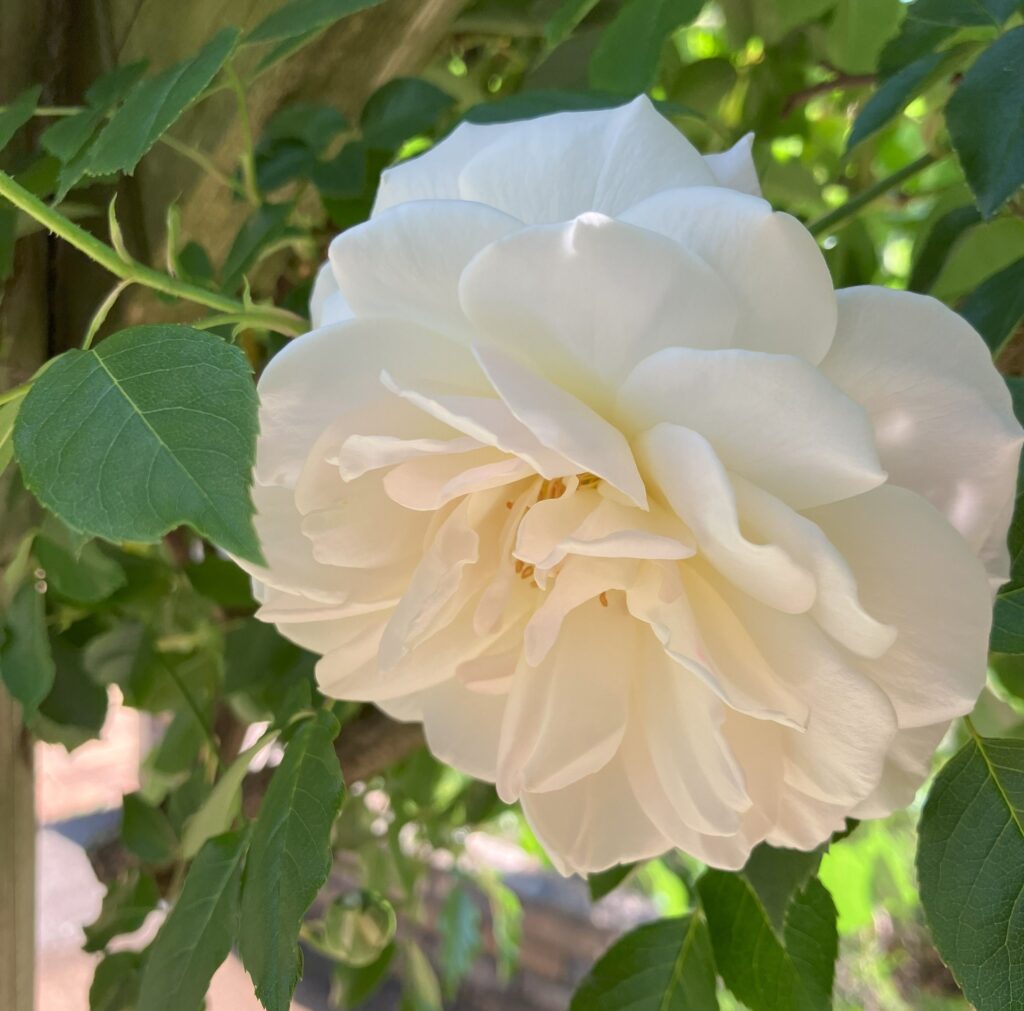
The scent is "slightly sweet."
In wine: something like Portugieser. Grown in cool places, modest in tannin — you'd expect that to mean a thin wine, and instead there's clear fruit to enjoy. Good slightly chilled, too.
Basics
- Class: Floribunda (FL)
- Bred in: Germany (Kordes)
- Year: 1958
- Colour: pure white, sometimes faintly cream
- Scent: light to medium, faintly sweet
- Form: semi-double to double, medium bloom
- Habit: 1–1.5m, upright to slightly spreading
Character
- One of the most famous white roses in the world, and consistently popular.
- Flowers generously and repeatedly from spring to autumn.
- The blooms shrug off rain, and it's remarkably easy to grow.
- Fairly disease-resistant. A good beginner's rose.
- There's a climbing form (Climbing Iceberg) for fences and arches.
Next, a charming red: Stéphanie de Monaco.
🌹 Stéphanie de Monaco

Hmm. This one is a bit cosmetic as well. Fine — let's call it Ruché.
I'm running out of vocabulary.
Ruché, for the record, is an indigenous variety from Piedmont in Italy. Strongly aromatic, and built on acidity and grip rather than fruit — an unusual taste, and very good against strongly flavoured food like a minced-meat ragù. If you see one, drink it.
Basics
- Class: Hybrid Tea (HT)
- Bred in: France (Meilland)
- Year: 1981
- Colour: deep rose pink to cherry pink
- Scent: medium, slightly fruity
- Form: high-centred, pointed petals — the classic rose shape — large bloom
- Habit: upright, 1.2–1.5m
Character
- Named after Princess Stéphanie of Monaco, and it carries the dignity.
- The form is beautiful: the textbook "rose-shaped rose."
- Repeat-flowering from spring through autumn.
- The scent is refined without being overwhelming, and it cuts well.
- Can be prone to powdery mildew, so give it good air movement.
Wrong season or not, other things were out and it was a good afternoon.
For the wine drinkers: Bonbon de Bourgogne (ボンボンデュブルゴーニュ).

And the one that matches the colour I picture when I hear "rose": Bonne Nuit (ボンヌイ).

The garden centre sells plenty of roses already in flower.
This one makes you want to give it to someone: Princesse Verte (プリンセスヴェール).

Early in the season it's mostly climbers, so this is what you get. I'd like to go back when the whole thing is in full flower.
Peak bloom is late May. (That's three times I've said it.)
And it'll be hot, so watch out for heatstroke.
Right — now I want to sit down slowly with a glass of Gewürztraminer.
Oh. Which Japanese grape variety smells most strongly of rose? I'll keep that question in my pocket and go looking.
※ The three roses at the end are given here with the Japanese names used at the garden, so you can search for them exactly.
This is the English edition of an article first written in Japanese. 日本語版はこちら.